Salāt ("Muslim prayer", Arabic: صلاة ṣalāh or gen: ṣalāt; pl. صلوات ṣalawāt) is one of the Five Pillars of the faith of Islam and an obligatory religious duty for every Muslim. It is a physical, mental and spiritual act of worship that is observed five times every day at prescribed times. In this ritual, the worshiper starts standing, bows, prostrates, and concludes while sitting on the ground. During each posture, the worshiper recites or reads certain verses, phrases and prayers. The word salat is commonly translated to prayer but this definition might be confusing. Muslims use the words "Dua" or "Supplication" when referring to the common definition of prayers which is "reverent petitions made to God."
Salat is preceded by ritual ablution. Salat consists of the repetition of a unit called a rakʿah (pl. rakaʿāt) consisting of prescribed actions and words. The number of obligatory (fard) rakaʿāt varies from two to four according to the time of day or other circumstances (such as Friday congregational worship, which has two rakats). Prayer is obligatory for all Muslims except those who are prepubescent, menstruating, or are experiencing bleeding in the 40 days after childbirth.[1]
Terminology[edit]
Salat (ṣalāh) is an Arabic word whose basic meaning is "bowing, homage, worship, prayer." In its English usage, the reference of the word is almost always confined to the Muslim formal, obligatory worship described in this article.
Translating salat as "prayer" is not usually considered precise enough, as "prayer" can indicate several different ways of relating to God; personal prayer or supplication is called duʿāʾ (Arabic: دُعَاء, literally "invocation") in Islamic usage.
Muslims themselves use several terms to refer to salat depending on their language or culture. In many parts of the world, including many non-Arab countries such as Indonesia, the Arabic term salat is used. The other major term is the Persian word namāz (نماز), used by speakers of the Indo-Iranian languages (e.g., Kurdish, Urdu, Hindi), as well as Turkish, Russian, Chinese, Bosnian and Albanian. In North Caucasian languages, the term is lamaz (ламаз) in Chechen, chak (чак) in Lak and kak in Avar (как).
Purpose and importance[edit]

Bosniaks praying in an open field, ca. 1906
The chief purpose of salat is to act as a person's communication with and remembrance of God. By reciting "The Opening", the firstsura (chapter) of the Quran, as required in daily worship, the worshiper can stand before God, thank and praise him, and ask for guidance along the "Straight Path".
Under the Hanbali School of thought, a person who doesn't pray five times a day is an unbeliever. The other three Sunni schools of thought say that the person who doesn't pray five times a day is an unholy sinner. Those who prescribe to the Hanbali view cite ahadith from Sahih Muslim that states that prayer is a dividing line between a believer and a non-believer.
In addition, daily worship reminds Muslims to give thanks for God's blessings and that submission to God takes precedence over all other concerns, thereby revolving their life around God and submitting to his will. Worship also serves as a formal method of dhikr or remembering Allah.[2]
Muslims believed all prophets of ALLAH offered daily prayers and they are humble submission to Oneness of ALLAH. Muslims also believed that the main duty of the prophets of ALLAH is to teach mankind to humble submit themselves to Oneness of ALLAH The God.[3]
In the Quran, it is written that: "For, Believers are those who, when Allah is mentioned, feel a tremor in their hearts, and when they hear His signs rehearsed, find their faith strengthened, and put (all) their trust in their Lord;"[4]
"To those whose hearts, when God is mentioned, are filled with fear, who show patient perseverance over their afflictions, keep up regular prayer, and spend (in charity) out of what we have bestowed upon them."[5]
Salat is also cited as a means of restraining a believer from social wrongs and moral deviancy.[6]
According to a hadith in the collection Sahih Bukhari, Muhammad considered salat "the best deed".[7]
The importance of the Salah was further demonstrated by Muhammad who on his deathbed and in the pangs of death would announce: الصَّلاةَ ، الصَّلاةَ وَمَا مَلَكَت أَيْمَانُكُم. "The Salah, I remind you of the Salah; and to look after the women."[8] His Companions described the scene saying, "The majority of the Messenger of Allah's advice – when death came to him – was 'The Salah; and to look after the women.' to the extent that his chest would be repeating these words, and his tongue ceased to express them."[9]
Conditions[edit]

Yemeni prayer during
North Yemen Civil War.
At the bottom of the central nave of the prayer hall there is a niche (the mihrab) indicating the qibla. This compulsory act of worship is obligatory for those who meet these conditions:[10]
- are Muslim
- are of sound mind
- have reached the age of puberty (beginning at age seven is recommended).[11]
Elements that make salat valid:[10]
- Confidence of the time of worship.[12]
- Facing the qibla, with the chest facing the direction of the Kaaba. The ill and the old are allowed leniency with posture.
- Covering the awrah[13]
- Clean clothes, body, place of prostration.
- Ritual purity (wudu, tayammum, ghusl)
- Praying in front of a sutrah[14] is recommended.
The place of worship should be clean. In a few cases where blood is leaving the body, salat is forbidden until a later time. Women are not allowed to pray during their menses and for a period after childbirth.[15][16][17]
Preparation[edit]
Cleanliness and dress[edit]
Islam advises that salat be performed in a ritually clean environment.[18] When worshipping, the clothes that are worn and the place of prayer must be clean. Both men and women are required to cover their bodies (awrah) in reasonably loose-fitting garments. The well-known adage or hadith by al-Nawawi that "purity is half the faith"[19] illustrates how Islam has incorporated and modified existing rules of purity in its religious system.
Ritual ablution[edit]

Women at Istiqlal Mosque,
Jakartawashing as
Main articles: Wudu, Tayammum and Ghusl
Before conducting salat, a Muslim has to perform a ritual ablution. The minor ablution is performed using water (wudu), or sand (tayammum) when water is unavailable or not advisable to use for reasons such as illness. Wudu is performed by Muslims according to the instructions of God given in the Quran:
"O you who believe! when you rise up to prayer, wash your faces and your hands as far as the elbows, and wipe your heads and your feet to the ankles; and if you are under an obligation to perform a total ablution, then wash (yourselves) and if you are sick or on a journey, or one of you come from the privy, or you have touched the women, and you cannot find water, betake yourselves to pure earth and wipe your faces and your hands therewith, Allah does not desire to put on you any difficulty, but He wishes to purify you and that He may complete His favor on you, so that you may be grateful."
— Qur'an, sura 5 (Al-Ma'ida), ayat 6[18]
More specifically, wudu is performed by Muslims by washing the hands, mouth, nose, arms, face, hair (often washing the hair is merely drawing the already wet hands from the fringe to the nape of the neck), ears, and feet three times each in that order. (It is not obligatory to wash the hair three times, once is sufficient, and men must also wash their beard and mustache when washing the face).
Call to prayer[edit]

A muezzin calling the adhan.
Main articles: Adhan, Muezzin and Iqamah
"Adhan" is the Islamic call to prayer, recited by the one is known as the muezzin for the five obligatory prayers, traditionally from a tower called a minaret. A second call immediately before praying, known as the Iqama, is for the assembled Muslims in the prayer area to line up for the beginning of the prayers.
Intention[edit]
Main article: Niyyah
The person should be conscious and aware of the particular salat that is being offered, whether it is obligatory, if it is a missed (qadha) worship, performed individually or among the congregation, a shortened traveller's worship etc. The explicit verbalization of this intention is not required. The person should think his worship to be the Last Worship so that he may perform the best he can.
How to conduct salat[edit]
Main article: Rakat
Each salat is made up of repeating units or cycles called rakats. The number of rakats for the five daily worship can be found below.
People who find it physically difficult can perform Salat in a way suitable for them.[note 1] A basic rakat is made up of these parts.
Standing[edit]
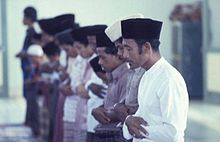
Men standing in prayer in
Indonesia.

A Muslim raises his hands to recite
Takbeeratul-Ihram in prayer
Main article: Standing in salat
- If this is the first rakat, the prayer is commenced by the saying of the takbir, which is اَللهُ أَكْبَرْ(transliteration "allāhu 'akbar", meaning God is Great). The hands are raised level with shoulders or level with top of the ears, with fingers apart and not spaced out or together. This is done before, with or after the takbir. Both arms are placed over the chest, with the right arm over the left.
- If this is the first rakat, a supplication praising God is said such as سُبْحَاْنَكَ اَلْلّٰھُمَّ وَ بِحَمدِکَ وَ تَبَارَکَ اسْمُکَ وَ تَعَاْلٰی جَدُّکَ وَ لَا اِلٰہَ غَیْرُكَ Subhaanak-Allaahumma, wa bihamdik, wa tabaarakasmuk, wa ta'aalaa jadduk, wa laa ilaaha ghayruk.
- The recitation of the Quran begins by asking refuge with God from the accursed devil by reciting أَعُوْذُ بِاللهِ مِنَ الشَّـيْطٰنِ الرَّجِيْمِ which is transliterated into Latin script as acūdhu bi-llāhi min ash-shayṭāni r-rajīm and followed by "سْمِ اللهِ الرَّحْمٰنِ الرَّحِيْمِ b-ism illāhi r-raḥmāni r-raḥīm (In the name of God, the entirely merciful, the especially merciful).
- Surah Al-Fatiha is recited as follows:
﴿١﴾الْحَمْدُ لِلَّـهِ رَبِّ الْعَالَمِينَ ﴿٢﴾ الرَّحْمَـٰنِ الرَّحِيمِ ﴿٣﴾ مَالِكِ يَوْمِ الدِّينِ ﴿٤﴾ إِيَّاكَ نَعْبُدُ وَإِيَّاكَ نَسْتَعِينُ ﴿٥﴾ اهْدِنَا الصِّرَاطَ الْمُسْتَقِيمَ ﴿٦﴾ صِرَاطَ الَّذِينَ أَنْعَمْتَ عَلَيْهِمْ غَيْرِ الْمَغْضُوبِ عَلَيْهِمْ وَلَا الضَّالِّينَ
(1) Alhamdu lillahi rabbi al-cālamīna (2) Ar-rahmani ar-rahīmi (3) Māliki yawmi ad-dīni (4) Iyyāka nacbudu waiyyāka nastacīnu (5) Ihdinā aṣ-ṣirāta al-mustaqīma (6) Ṣirāta al-ladhīna ancamta calayhim ghayri al-maghdūbi calayhim walā aḍ-ḍāllīna
- For the first or second rakat only, the recitation of Al-Fatiha is followed with a recitation from any other section from the Quran of choice.
- The takbir is said again and the hands are raised as previously described and the next position, bowing or ruku', begins.
Bowing[edit]
Main article: Ruku'
- The palms are placed on the knees. Ideally, fingers are spaced out and the back is erected at an angle at which poured water may not fall from it.
- Some of many types of remembrances of God are recited for this situation such as سبحان ربى العظيم (transliteration subḥāna rabbī al-caẓīm, meaning "Glory to my Lord, the Most Magnificent") three times or more.
Second standing[edit]
- I'tidal is the standing again after ruku'. The back is straightened and the hands are raised as in takbir as mentioned before but saying سمع الله لمن حمده (transliteration samica allāhu li-man ḥamidah, meaning "Allah listens and responds to the one who praises him.")
- Some of many praises to God are said for this situation such as ربنا لك الحمد (transliteration rabbanā wa-laka al-ḥamd, meaning "O our Lord! And all praise is for You.")
- The takbir is said and the hands can be raised as mentioned before as the next position, prostration, begins with hands reaching the ground before knees.
Prostration
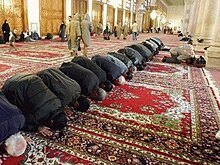
Muslims in prostration in
Syria.
Main article: Sujud
- As much of the ground must be felt by the nose as the forehead. The elbows are raised and the palms are on level with either the shoulders or the ears, with fingers together.
- Some of many types of remembrances of God are recited for this situation such as سبحان ربى الأعلى وبحمده (transliteration subḥāna rabbī al-'aclā wa-bi-ḥamdih meaning "Glory to my Lord, the Most High Most Praiseworthy") three times or more.
- The takbir is said again and the hands can be raised as mentioned before while the next position, kneeling, begins.
Sitting[edit]
Main article: Sitting in salat

Men sit and pray in
Kosovo
- While sitting, either the left foot is placed along the ground with the right foot upright or both feet are kept upright.
- Some of many types of remembrances are recited for this situation such as rabb 'ighfir lī, rabb 'ighfir lī (meaning "O my Lord, forgive me! O my Lord, forgive me!")
- The takbir is said again and the hands can be raised as mentioned before as the second prostration begins.
Second prostration[edit]
- Second prostrations are done exactly as the first time.
- The head is raised and the takbir is said again and the hands can be raised as mentioned before. For every second and last rakat only you would go to the sitting position again. Otherwise, the standing position begins again for the start of a new rakat.
Second sitting[edit]
See also: Tashahhud and Taslim
- If this is the second raka'ah, sitting is done as before. If this is not part of the second raka'ah, then the left thigh is leans against the ground and both feet are protruding from the right side with the right foot either upright or along the ground. The left palm leans on the left knee.
- The right index finger is pointed towards the qibla.
- The Tashahhud is recited: التَّحِيَّاتُ لله وَ الصَّلَوَاتُ وَ الطَّيِّبَاتُ السَّلاَمُ عَلَيْكَ أَيُّهَا النَّبيُّ وَ رَحْمَةُ اللهِ وَ بَرَكَاتُهُ السَّلاَمُ عَلَيْنَا وَ عَلَى عِبَادِ اللهِ الصَّالِحِينَ أَشْهَدُ أَنْ لا إلهَ إلا اللهُ وَ أَشْهَدُ أَنَّ مُحَمَّداً عَبْدُهُ ورَسُولُهُ
At-tahiyyatu lillahi wa 's-salawatu wa 't-tayyibatu. As-salamu `alayka ayyuha'n-nabiyyu wa rahmatullahi wa barakatuh. As-salamu `alayna wa `ala `ibadillahi's-saliheen. Ashadu an la ilaha illa Allah wa ashhadu anna Muhammadan `abduhu wa rasuluh.
(All the salutations, prayers and good things are for Allah. Peace be on you O Prophet, and the blessings of Allah, and His grace and blessings. Peace on us and on all the righteous servants of Allah. I bear witness that none but Allah is worthy of worship and bear witness that Muhammad is the Servant and Messenger of Allah.)
- Greetings on Muhammad are recited:
اللَّهُمَّ صَلِّ عَلَى مُحَمَّدٍ وَعَلَى آلِ مُحَمَّدٍ كَمَا صَلَّيْتَ عَلَى إِبْرَاهِيمَ وَعَلَى آلِ إِبْرَاهِيمَ إِنَّكَ حَمِيدٌ مَجِيدٌ اللَّهُمَّ بَارِكْ عَلَى مُحَمَّدٍ، وَعَلَى آلِ مُحَمَّدٍ كَمَا بَارَكْتَ عَلَى إِبْرَاهِيمَ وَعَلَى آلِ إِبْرَاهِيمَ إِنَّكَ حَمِيدٌ مَجِيدٌ
Allahumma salli `ala Muhammadin wa `ala ali Muhammadin kama sallaita `ala Ibrahima wa `ala ali Ibrahima Innaka hameedun Majid Allahumma barik `ala Muhammadin wa `ala ali Muhammadin kama barakta `ala Ibrahima wa `ala ali Ibrahima Innaka hamidun Majeed.
(O Allah, send grace and honour on Muhammad and on the family and true followers of Muhammad, just as you sent Grace and Honour on Ibrahim and on the family and true followers of Ibrahim. Surely, you are praiseworthy, the Great. O Allah, bless Muhammad and the family and true followers of Muhammad, just as you blessed Ibrahim and the family and true followers of Ibrahim. Surely, you are praiseworthy, the Great.)
- If this is not the last raka'ah, a new raka'ah begins by standing up again with the takbir and the hands can be raised as mentioned before.
- If this is the last raka'ah, the greetings of taslim are said to the right such as السلام عليكم ورحمة الله (transliteration "As-Salaamu 'alaykum wa rahmatullaah," meaning "May Allaah grant you peace and security, and may His Mercy be upon you") and then similarly to the left.
| Performing theTaslim | 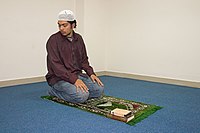 |  | | |
| Reciting the salam facing the right direction | Reciting the salam facing the left direction | | |

.jpg)


